
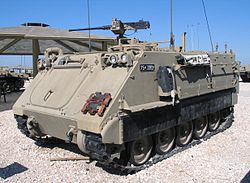
| M113 ברדלס / Bardelas / "Cheetah" | |
 | |
| Type | Armored Personnel Carrier |
| Country of Origin | USA |
| Production Year | 1960 |
| Previous Model | M59 |
| Next Model | M2 Bradley |
| Wars | Yom Kippur |
| Vietnam | |
| First Lebanon War | |
| Number Built | approx 80,000 |
| Tech Specifications | |
| Length | 4.86 m |
| Width | 2.686 m |
| Height | 2.5 m |
| Speed | 64 kpm (max) |
| Range | 550 km |
| Main Armament | 7.62 MAG or M2 machine gun |
| Engine | diesel 210 hp |
| Armor | 12-38 mm aluminum |
| Crew | 2 + 8 passengers |
The M-113 is the name of a family of armored personnel carrier developed and manufactured in the USA in the 1960s. This APC has been deployed in more than 50 countries to date, including the USA and Israel. The M-113 is a light inexpensive APC and its purpose is to transport soldiers to and from the battlefield. Today, the APC is considered to have inadequate protection: the body is made of aluminum to save weight but allows it to be penetrated by anti-tank weapons and even general ammunition from powerful machine guns such as the M2 Browning.
- 1 Overview and History
- 2 M-113 in Israel
- 3 Models
- 3.1 Models in the IDF
- 4 Technical Specifications
- 5 External Links
- 6 Footnotes
Overview and History
The M-113 first entered service in 1960 and was developed using the experience gained from the M59 and M75 APCs designed by Ford and Kaiser Aluminum and Chemical in the late 1950s. This tracked vehicle has the amphibious ability to cross shallow water obstacles and is capable of travel on both the road and over open ground. The M-113 family has dozens of types for both combat and combat support. The number of vehicles produced of the various models is over 80,000.
The M-113 was the first modern 'battle taxi' designed to transport infantry on the mechanized battlefield. The armored personnel carrier required a two-man crew to operate it with an M2 Browning heavy machine gun as its main weapon and a 7.62 mm machine gun as a secondary weapon. The M-113 has an aluminum chassis like those used to build fighter jets with aluminum being a relatively strong metal but might lighter than steel. The rationale for using aluminum was to reduce the weight of the vehicle but this involved a tradeoff with protection. The M-113 is a very light vehicle (13 tonnes), which allows it to use a small diesel engine (less than 300 hp) as well as the ability to be transported by air which was a very important consideration for the US Armed Forces because of their operations around the world.
The choice to use aluminum to reduce weight has made this vehicle extremely vulnerable. Anti-tank missiles easily penetrate the aluminum armor injuring or killing everyone inside, but even light ammunition can penetrate the armor, earning the M-113 a bad reputation among the US soldiers who had to use it. Some chose to sit outside on the roof because they felt that it was suicide to sit inside.
The M-113 underwent a number of upgrades, the latest being the M-113-A3, which had an armored external fuel tank (NB: ???) and a more powerful engine and transmission to all for the installation of additional armor.
The M-113 served in many wars among them the US war in Vietnam. It has also served in some 50 NATO countries (NB: As of 2017 there are 29 members states in the NATO Alliance.) and in many conflicts around the world. In the 1970s Israel was equipped with a large number of M-113 APCs and they have served in all of the wars since that time, and Israel's operations include the Yom Kippur War, Operation Peace for the Galilee, the First Intifada, the Second Intifada, the Second Lebanon War, Operation Cast Lead and Operation Tzuk Eitan.
M-113 in Israel
The first sample of these APCs arrived in Israel in 1971 but most of them arrived as part of the airlift of supplies, weapons and eqipment sent to Israel by the USA during the Yom Kippur War. This APC was to replace the M-3 half-tracks that were destroyed in great numbers by the artillery and the anti-tank weapons of the enemy.
Israel received a large number of M-113 APCs for free and because the number was so large it becamse the IDF's primary APC. To address the low level of armor protection on the APC, additional armor for the vehicle was manufactured by IMI, that was place 250mm away from the APC (this method is known as 'spaced armor'). The additional armor was called 'vayzata' (ויזתא) and it was installed on some of APCs before Operation Peace for the Galilee and an APC with 'vayzata' was called a 'Zelda' (זלדא). Although the 'vayzata' improved the survivability of the APC, the additional weight strained the engine and reduced the mobility of the vehicle.
The M-113 participated in Operation Peace for the Galilee and in both of the Intifadas. Despite the additional armor, many of the APCs were not upgraded with it and the vehicle remained vulnerable. Some soldiers in the IDF would call it 'zippo' (זיפו) because of its tendency to catch fire after being hit by heavy weapons. During the Lebanon War troops began to improvise to improve protection by adding sandbags around the body of the APC, hoping that the sand would at least block fire from light weapons and small shells (up to 23 mm) while the M-113 another but more irreverent nickname, NAGMA"CHOL (נגמ״חול NB: an acronym combining NAGMA"SH and CHOL, APC and sand. What makes the terms irreverent I cannot say but someone who knows Hebrew better than me might have a better idea.) (during Operation Defensive Shield there were sandbags added to most of the APCs given to reserve units that participated in the operation as standard protection).
During the Second Intifada APCs played a significant role in the fighting, but they became notorious for the "APC Disaster" of 2004 in the Gaza Strip. The incident led to much criticism of the use of these vulnerable and obsolete APCs in the Gaza Strip leading to a decision to remove them from the Gaza Strip and to use more heavily armored APCs available to the IDF. It was also decided to develop a new series of heavy armored APCs based on the Merkava tank. In 2005, an APC was unveiled. (NB: the NAME"R APC.) The IDF also ordered L-VAS protection for 100 vehicles, armor designed to give the M-113 more protection against anti-tank missiles such as the RPG-7. (NB: L-VAS, light vehicle armor system manufactured by IMI at the plant in Slavin.)
In 2014 during Operation Tzuk Eitan in the Gaza Strip, seven IDF soldiers from the Golani Brigade were killed when an anti-tank missile hit the M-113 that they were in. Following this incident, a decision was made to completely remove the APC from combat service, and replace it with NAME"Rs even though the M-113 would still continue to serve combat support troops.[1] There was also a decision made to convert Merkava Siman 2 tanks into APCs known as אופק/Ofek/Horizon to also replace the M-113. In addition, all of the NAME"Rs would be protected by the windbreaker system[2], but it is not clear if this is enough to protect them. (NB: a prototype of the Ofek was tested in 2015.)
Models
- M113: Base model.
- M113A1: upgraded with 215 hp diesel (replaced the 209 hp gasoline engine).
- M113A2: improved suspension, engine cooling and exhaust systems as well as a changed fuel tank configuration.
- M113A3: upgrades to the vehicle's armor protection.
In addition to the main APC model, there were also various versions based on base models, including:
- M106 - Mortar APC, containing a 120mm mortar that is fired from inside the APC.
- M163 - Anti-aircraft APC with M61A1 Vulcan anti-aircraft gun.,
- M577 - Command APC that is taller in the rear and has an external power unit (generator).
- M578 M579 - maintenance and recovery for the armored forces.
- M901 - anti-tank APC mounting a BGM-71 TOW missile launcher.
- M981 - Forward Observer APC for artilley.
- M1015 - Electronic warfare carrier.
IDF MODELS
The official IDF name for the M-113 is 'Cheetah' but among the soldiers it more commonly called the Zelda or the NAGMA"SH.
Like the US Army, the M-113 also serves as the base for a wide range of combat vehicles configurations:
- M163 Chovet/Hit and M163 Mechvet/Racket: mobile anti-aircraft gun based on the US M163 SPAA which is based on the M113. The Hit is armed with a M26A1 Vulcan cannon while the Racket, an improved version of the Hit, is armed with a Stinger missile launcher. In 2006, the IDF took the Racket out of service.
- MIM-72 Tsaparal/Chaparral: a ground-to-air missile system based on the M113.
- Giraffe: a M113 APC with a Ourev/Crow anti-tank rocket launcher. (NB: Crow is the US TOW missile.) The IDF no longer uses these missiles. The APC had a device to raise the missile launcher and allow it to peer over a ridge when it was fired and then lower to hide again after the launch so the vehicle did not have to move back and forth, up and down, over and over again as it fired.
- Armored Ambulance
- Mugaf/Closed: artillery command vehicle and electronic warfare.
- Alpha: carries artillery shells. A vehicle with a rear cargo area to transport artillery shells. Used by the Artillery Corps.
- Batshalot/Payments: a M113 with a radar.
- Technical and Peter: Armored Corps vehicles carrying technical staff whose mission is to recover and repair damaged vehicles on the battlefield.
- NAGMA"SH Classical: An improved M113 APC with reactive armor on the front and sides of the vehicle, as well as improvements to the braking system. Was widely used in the Lebanon sector at the end of the 1990s.
- NAGMA"SH Kasman: The M113 is equipped with an enclosed superstructure (similar to the Nagmachon)(NB: the NAGMACHO"N is a heavy APC built on a tank chassis.) designed to prevent disturbances in the territories (KASMA"N stands for 'The Magic of the Music'). ( קסמ״ן - קסם המנגינה KASMA"N - kesem ha-mangina)
- NAGMA"SH Urban Fighter: An M113 APC adapted for combat in a built-up area. The APC is equipped with reinforced glass windows, a dome that enables 360 degree observation, armor against heavy machine guns, and anti-rocket cage shielding.[4]
- Kashet (mortar): M113 APC carrying a 120mm mortar made by Soltam.
- Zelda: M113 NAGMA"SH with vayzata shielding: 'spaced armor' of steel plates 250mm away from the original armor to protect against anti-tank missiles and manufactured by IMI. Further improvements were made by Rafael in terms of strength and weight reduction.
- Zelda 2: Added a reactive armor against anti-tank missiles
- L-VAS: Modern Light Vehicle Armor System manufactured by IMI, which included passive composite and reactive armor that was designed to increase survivability against light anti-tank threats (such as anti-tank rockets, 20mm machine guns and light anti-tank missiles such as the Sagger).
According to estimates, the IDF has about 10,000 APCs (M113) in service including all versions and configurations. The M113 serves in all IDF combat units, including infantry brigades, armor, artillery, combat engineering and others.
Technical Specifications
General
- Made: United States
- Main Role: "battlefield taxi", transporting soldiers safely to the field of battle
- Secondary Role: Base for other armored combat vehicles.
- Carrying Capacity: two crew and ten passengers
Dimensions
- Length: 4.84 m for M113A1, 5.29 m for M113A2.
- Width: 2.54 m
- Height: 2.54 m
- Max Weight: 12,000 kg (26,000 lbs) loaded (12 tonnes) unloaded 10.8 tonnes
- Fuel Tank: 360 liters (95 gallons)
Performance
- Speed: 64 kph
- Speed When Crossing Water Obstacles: 9 kph
- Range of Operations: 550 km
Propulsion
- Engine: GMC Diesel two-stroke GM6V53
- Power: 210 hp (160 kW) at 2800 rpm
- Transmission: Allison TX 100-1
- Tracks and Suspension: 38 cm wide track with 64 links on right side, 63 links on the left, 5 pairs of 61 cm bogey/buggy wheels on each side, 4 shock absorbers on M113A1 two front and rear, on M113A2 added two more front brakes.
Arms and Armaments
- Basic Armement:
- 1 x 7.72 mm MAG
- Additional Armaments: varies depending on the model
- 1 x Browning M2 machine gun 12.7mm
Armor (data refere to original American version
- Basic armor: 5058 aluminum
- Additional armor: variable
- Media and files on M113 in Wikimedia Commons
- M. Jerusalem, M-113, Systems 205, February 1970, pp. 46-49
- The M-113, in its various forms, is on the Israeli-weapons site
- M-113 - Overview of the Israeli-weapons site
- M-113 Zelda, on the Israeli-weapons site
- Shachar Ruppin, Following Tzuk Eitan: Ground Forces Examining Acquisition of New Type of APC, IDF Spokesperson's Website, 27.11.2014
- Amir Buhbut, IDF future armored personnel carrier will be protected in "Ma'aleh Ruach", Walla !, 7.9.2014
- From the IDF Spokesperson's website
- [update.com/newscast/0707/news/150707_urbanfighter.htm]
- GlobalSecurity.org, Israel - Army Equipment
External Links
Footnotes